
The liquidity-fuelled rally will continue for some time, however, fundamentals are getting stretched.

The Sensex jumped nearly 900 points and the Nifty rallied over 272 points on Friday, bouncing back from the previous day's fall, following a positive trend in global equities and fresh foreign fund inflows. The BSE Sensex rallied 899.62 points or 1.53 per cent to end at 59,808.97 after starting the trade on a positive note. During the day, it jumped 1,057.69 points or 1.79 per cent to 59,967.04.

Wipro, Power Grid, Larsen & Toubro, Mahindra & Mahindra, Tech Mahindra, NTPC, Titan, Tata Consultancy Services and HCL Technologies were among the other major winners. Bajaj Finance, IndusInd Bank, Asian Paints, Hindustan Unilever, Axis Bank, ICICI Bank, Reliance Industries and HDFC Bank were among the laggards.

Shares of Reliance Industries climbed around 3 per cent to hit a record closing high of Rs 2,060.65. SBI, ICICI Bank, Tech Mahindra, ITC and Kotak Bank were among the other winners. NSE Nifty advanced 82.85 points, or 0.74 per cent, to close at 11,215.45.
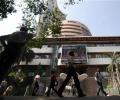
Global events will continue to be in the limelight, besides domestic policy.

Equity benchmarks extended their decline for the fourth straight session on Wednesday, with the Sensex falling 214.85 points after the Reserve Bank raised the key interest rate by 50 basis points. Continuous foreign fund outflows and surging crude oil prices also weighed on markets. The 30-share BSE benchmark dropped 214.85 points or 0.39 per cent to settle at 54,892.49.
The domestic equity market, which is on a record-breaking spree, will focus on macroeconomic data announcements, movement in global stocks and the US Fed minutes to get further direction, analysts said. Trading activity of Foreign Institutional Investors (FIIs) will also innfluence investors.From the domestic macroeconomic front, Purchasing Managers' Index (PMI) data for the manufacturing sector will be released on Monday, and that o,f the services sector on Wednesday. Investors, this week, will keenly watch major global market events, icluding the outcome of the Federal Open Market Committee (FOMC) minutes, scheduled to be out on Wednesday.

Equity investors became poorer by Rs 7.48 lakh crore in five consecutive days of market fall, where the BSE Sensex has declined by nearly 3 per cent. In the past five days, the BSE Sensex has tumbled 1,713.71 points or 2.79 per cent. This has led to an erosion of Rs 7,48,887.04 crore from the market capitalisation of BSE-listed firms in five trading sessions.

The outbreak of the Omicron variant of the coronavirus and unprecedented lockdowns in China have roiled its equity market and also that of Hong Kong. After the crisis-hit Sri Lanka, China and Hong Kong are the worst-performing stock markets in Asia on a year-to-date basis.

Despite the large economic impact of the Covid-19 pandemic, the markets have recovered sharply even though the performance among individual stocks has been quite polarised.

The broader NSE Nifty sank 177.65 points or 1.53 per cent to 11,419.25.

Shares of most of the Adani group firms ended lower on Monday, with the group companies' combined mcap witnessing a sharp fall of Rs 9.5 lakh crore after US-based short-seller Hindenburg Research's adverse report.

Top gainers in the Sensex pack included Tata Steel, Kotak Bank, NTPC, HDFC twins, PowerGrid and ONGC, rising up to 4.60 per cent.

Equity investors became richer by over Rs 5.77 lakh crore on Tuesday, helped by a rally in the broader market where the BSE benchmark jumped nearly 2 per cent. The BSE Sensex zoomed 934.23 points or 1.81 per cent to settle at 52,532.07. Driven by the rally in equities, the market capitalisation of BSE-listed firms jumped by Rs 5,77,006.83 crore to stand at Rs 2,40,63,930.50 crore. "Absence of fresh selling triggers in the domestic and global economy along with falling commodity prices relieved the heavily discounted equity market to showcase recovery.

Top gainers in the Sensex pack were Tata Motors, ONGC, Yes Bank, IndusInd Bank and Vedanta -- rising up to 2.71 per cent.

Jio is planning to win over 350 million 2G feature phone users by launching a smartphone at a fraction of the current cost.

Analysts have given a thumbs up to the Reliance Industries (RIL) and Walt Disney Co. (Disney) proposed a joint venture (JV). The stock of the Mukesh Ambani-controlled company gained nearly 1.5 per cent on Thursday to Rs 2,952 levels as compared to the S&P BSE Sensex that traded marginally weak, down 0.2 per cent to 72,172 levels in intra-day trades.

Equity benchmarks Sensex and Nifty faced heavy drubbing on Thursday, falling over 1 per cent each, in tandem with weak global markets following the US Federal Reserve's interest rate hike and its hawkish stance. The 30-share BSE Sensex tanked 878.88 points or 1.40 per cent to settle at 61,799.03. During the day, it tumbled 962.3 points or 1.53 per cent to 61,715.61.

Liquidity issues post the crisis at DHFL, progress of monsoon, rupee trajectory at the domestic level and oil prices are some factors that will keep markets choppy, analysts say.
ITC was the top gainer in the Sensex pack, rallying over 7 per cent, followed by Asian Paints, Hero MotoCorp, Maruti, Bajaj Auto, Sun Pharma, TCS and HCL Tech. On the other hand, IndusInd Bank, NTPC, Bajaj Finance, HDFC and L&T were among the laggards. NSE Nifty advanced 39.70 points, or 0.44 per cent, to 9,106.25.

Equity benchmarks Sensex and Nifty ended on a mixed note on Wednesday as the euphoria about the Budget fizzled out, with investors going for profit-taking ahead of the Fed interest rate decision. The 30-share BSE benchmark Sensex climbed 158.18 points or 0.27 per cent to settle at 59,708.08 after it trimmed most of the intra-day gains. During the day, it had zoomed 1,223.54 points or 2 per cent to 60,773.44.

All Sensex components ended in the red. SBI was the top loser, followed by ONGC, Axis Bank, ITC, Titan, Bajaj Auto, TCS and IndusInd Bank.

An aggressive rate hike by the US Fed and the possibility of a recession can trigger a slide in these stocks, which will be a good opportunity to buy from a long-term perspective.

A slowdown in hiring by India's top IT companies has resulted in a sharp increase in the industry's profit per employee in Q3FY23. The top four IT companies earned a net profit of 1.7 lakh per employee during October-December 2022, up 8.6 per cent from Rs 1.57 lakh in Q2FY23 and 16.3 per cent from a record low of Rs 1.47 lakh in Q1FY23. Earnings per employee in the third quarter were, however, still down 0.9 per cent on a year-on-year (YoY) basis.

Equity indices chalked up losses for the second straight session on Monday, in tandem with a bearish trend overseas as ratcheting up of hostilities in Ukraine and prospects of further rate hikes by the US Fed soured global risk sentiment. The rupee slipping to another all-time low against the US dollar amid foreign fund outflows added to the gloom, traders said. After tumbling over 800 points in intra-day trade, the 30-share BSE Sensex clawed back some lost ground to end 200.18 points or 0.34 per cent lower at 57,991.11.

In India, it is not easy to fight it out with the large banks which are nimble-footed and technology-savvy and are continuously innovating on the retail turf with newer products for customer acquisition.

FPIs have turned net sellers in 2022 after being net buyers in the last three years.
The Indian markets have seen a good run in the last three months with the S&P BSE Sensex rising around 7 per cent and the Nifty50 moving up 7.5 per cent. The next leg of the market rally from here on, analysts suggest, will be driven by a growth in corporate earnings over the next few quarters. That said, they do not expect material / sharp downgrades to India Inc's earnings estimates despite headwinds for the economy.

The impact of currency depreciation can also be mitigated by holding a portion of your investment portfolio in dollar-denominated assets.

Back home, the Nifty IT index - a gauge of the performance of the IT stocks on the National Stock Exchange (NSE) that has closely mirrored the performance of NASDAQ over the past few years - has lost nearly 2 per cent in CY23.

Fundraising through the issuance of shares to qualified institutional investors has seen hectic activity in the first half of the current fiscal year (FY24), with 20 companies mobilising over Rs 18,400 crore, more than four-fold from the year-ago period, on positive investors' sentiments. Moreover, the robust trend of Qualified Institutional Placements (QIPs) in the first half of the fiscal year 2023-24 is expected to persist throughout the second half of the year too, Sanjay Moorjani, Research Analyst at SAMCO Securities, told PTI. Prashant Rao, director and head of equity capital markets, Anand Rathi Investment Banking, said that market and investor sentiments play an important role for these issuances.

Investors should view any bounce-back in bank stocks as an opportunity to exit the pack, analysts suggested, as the worst may not be over yet. The recent quarterly results of HDFC Bank and Axis Bank disappointed the Street, triggering a marketwide selloff by foreign institutional investors, especially in banking counters. While HDFC Bank, which was the anchor for the market correction during the past week, ended 2 per cent higher amid short covering on Wednesday, Axis Bank's shares settled 3 per cent lower.

After rallying 543 points in the morning session and touching the 40,000-mark, the BSE Sensex surrendered all gains to close at 38,628.29, showing a loss of 839.02 points or 2.13 per cent. Similarly, the NSE Nifty tanked 260.10 points or 2.23 per cent to end at 11,387.50.

From the peak of $3.67 trillion in January, India's market cap has eroded by $676 billion amid rising bond yields and a record-breaking sell-off by overseas investors.

Over half, or 269 NSE 500 stocks, have given over 10-fold (10x) returns in the last two decades, finds a recent report by Goldman Sachs that analysed 10 major markets across emerging and developed markets (EM/DM) that covered 6,700 stocks. The report examined '10-baggers' - stocks that have generated at least 10x total returns within a rolling 5-year period over the past two decades. Some of the prominent ones that comprise these 269 stocks in the Indian context stocks that delivered over 10x total returns over a 5-year rolling period since 2000 as per Goldman Sachs includes Westlife Foodworld, Bharti Airtel, Adani Total Gas, Patanjali Foods, Larsen & Toubro, BEML, Blue Star, Shree Cement, Lupin, Godrej Industries, Astral, Adani Enterprises, Hindustan Petroleum and Deepak Fertilisers.

At this year's TIME ball in New York City on Thursday, April 25, you would have run into a Coimbatore-born American scientist, looking lovely in Sabyasachi Mukherjee designer finery, who would most likely have been hanging out with Dua Lipa.

'We want to make sustainability affordable.' 'We tell everyone, don't just recycle, Craste it!'

Less-than-expected rainfall and a poor spatial distribution, experts say, can rekindle fears of a rise in food and fuel inflation that can have an impact on the RBI's monetary policy. The fear of less than optimal rainfall due to El Nino this year, analysts believe, is the biggest short-term risk for the markets, which they said has not been fully priced in yet by them. Monsoon set over Kerala on June 08, a week later than its scheduled date.

Analysts caution a non-BJP government is not an impossible scenario. In case of a Modi-led coalition, they advise investors to focus on discretionary consumption, select private banks and financials, RIL, housing, and IT.

From the Sensex pack, Tata Steel, IndusInd Bank, Infosys, UltraTech Cement, NTPC, Bajaj Finance, Hindustan Unilever, Tata Consultancy Services, ICICI Bank and Maruti were among the major winners. Titan, Nestle, Larsen & Toubro, Axis Bank, ITC and Asian Paints were among the major laggards.
